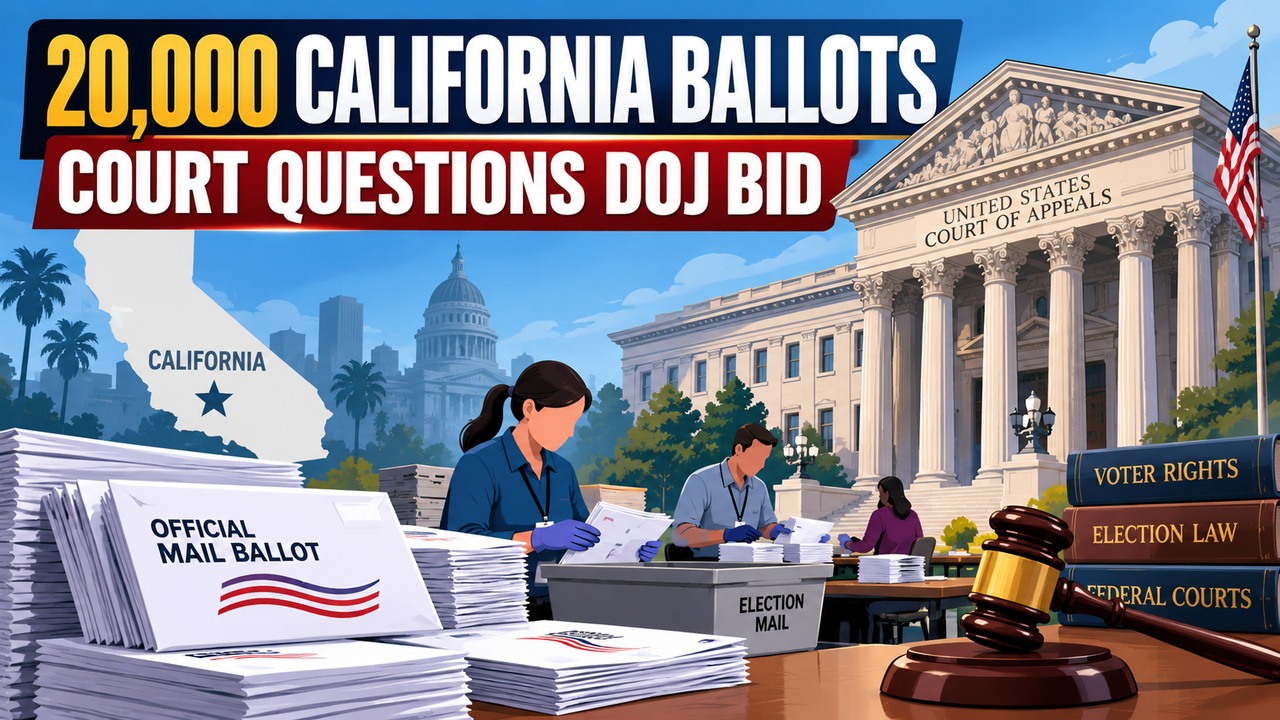
Federal Appeals Court Questions DOJ Bid to Set Aside 20,000 California Mail Ballots
Federal Appeals Court Questions DOJ Bid to Set Aside 20,000 California Mail Ballots: Fresh Concerns Over Voter Rights, Election Authority, and Democracy (October 26, 2026)
Updated: October 26, 2026 · Status reflects the October 25 Ninth Circuit hearing; no appellate ruling had been issued in the reports reviewed
A three-judge panel of the U.S. Court of Appeals for the Ninth Circuit pressed Justice Department lawyers on October 25 about their emergency request to set aside roughly 20,000 California mail ballots associated with people the federal government suspects may be noncitizens. The judges questioned the timing of the appeal, the court’s authority to intervene before a lower-court ruling, and how the requested order would fit with constitutional rules governing election administration.
The Justice Department says federal officials identified more than 20,000 people they believe are likely noncitizens on California’s voter rolls and wants related ballots segregated until citizenship can be verified. California and Los Angeles County challenge the reliability and legal basis of the request, arguing that unverified data could sweep in eligible voters and disrupt election administration. The allegations remain contested; the list is not a court finding that 20,000 noncitizens cast ballots.

1. What happened in the California mail-ballot case?
The Justice Department filed a federal lawsuit against California on October 15, 2026. Working with the Department of Homeland Security, federal agencies said they had identified more than 20,000 people who they believed were likely noncitizens registered in California and had been sent vote-by-mail ballots. DOJ asked a federal court to require state officials to set aside ballots associated with those people and not count them until citizenship was verified. The government’s position is that the state failed to review the list after federal officials provided it and gave California a 48-hour deadline.
California disputes the premise and scope of the request. State officials say the list was not adequately verified and that matching records from different systems can incorrectly flag U.S. citizens, inactive or cancelled registrations, and other people who may not have cast ballots. Los Angeles County said its review of a small sample identified records that appeared inaccurate or insufficient to establish ineligibility. The sample has not established the status of every name on the full list, but it is part of the state and county argument that the proposed blanket remedy is unsafe.
The dispute reached the Ninth Circuit after DOJ sought emergency action while the district judge assigned to the case had scheduled a hearing for October 27. During a rare Sunday argument on October 25, two judges on the three-member panel questioned parts of the government’s legal and procedural theory. The panel did not issue an immediate ruling, according to AP, Reuters and other reporting, and said it would try to act quickly.
The headline figure of 20,000 needs careful interpretation. It refers to people the federal government flagged as likely noncitizens on voter-registration records and linked to mail ballots being sent—not 20,000 individual cases already proven to involve unlawful voting. Registration, being mailed a ballot, returning a ballot and casting an unlawful vote are different events. The court has not established that everyone on the list is a noncitizen or that every person identified submitted a ballot.
| Issue | What is established in the cited reporting | What remains disputed or unresolved |
|---|---|---|
| The 20,000-person list | DOJ says it identified more than 20,000 people it believes are likely noncitizens and provided the list to California officials. | The accuracy of each record, the citizenship of each person, and whether each person returned or cast a ballot are not established by the list alone. |
| DOJ’s requested remedy | The government seeks to segregate associated mail ballots and delay tabulation until citizenship is verified. | Whether the requested order is legally authorized, procedurally available, and workable this close to an election. |
| California’s response | The state disputes the federal approach and says the data and remedy risk wrongly affecting eligible voters. | The courts have not resolved the merits of the federal allegations in the reports reviewed. |
| Appeals court hearing | The Ninth Circuit heard emergency arguments on October 25 and questioned the government’s position. | As of October 26, the panel had not issued a decision in the reports reviewed. |
| Next district-court event | A hearing on DOJ’s request was set for October 27. | What orders, if any, the district court or appeals court will issue. |
2. Timeline: from DOJ’s list to the Ninth Circuit hearing
The timing matters because California’s November 3, 2026 general election was approaching and mail ballots were already being processed. A request that might be handled through ordinary litigation earlier in an election cycle can become an emergency question when election officials are preparing, receiving and tabulating ballots.
| Date | Event | Why it matters |
|---|---|---|
| October 13–14, 2026 | California officials said DOJ demanded review of a list it described as people likely to be noncitizens and gave a 48-hour deadline. California said the Secretary of State’s office did not initially receive the list directly; Los Angeles County received it on a protected thumb drive. | The method and timing of delivery became part of the dispute over the feasibility and adequacy of the requested review. |
| October 15, 2026 | DOJ filed its lawsuit against California and publicised its claim that more than 20,000 likely noncitizens were registered and had been sent ballots. | The federal government asked the court to prevent tabulation of associated ballots until citizenship could be verified. |
| October 20, 2026 | The California Secretary of State issued a public update and said the state had filed opposition. It also cited accuracy concerns in Los Angeles County’s small-sample review. | The state’s position became public: enforce eligibility rules, but do not use unverified information to risk eligible voters’ ballots. |
| October 21, 2026 | U.S. District Judge David O. Carter received the case and set a hearing on the request for temporary relief for October 27, according to court coverage. | DOJ argued that waiting until the scheduled hearing was too slow because ballot processing was already underway. |
| October 22–23, 2026 | The federal government filed a notice of appeal and an emergency request for an injunction pending appeal, arguing the district court’s schedule effectively denied urgent relief. | California argued the appeal was premature because the district court had not yet ruled on the request; DOJ countered that the delay functioned as a denial. |
| October 25, 2026 | A three-judge Ninth Circuit panel heard expedited oral arguments. Two judges challenged aspects of the government’s timing, jurisdiction and constitutional theory. | The panel did not issue a decision immediately but said it would attempt to rule quickly. |
| October 26, 2026 | Reports available for this article said the appellate decision remained pending. The district-court hearing was scheduled for October 27. | Both courts could affect how the dispute proceeds before the November 3 election. |
The timeline is based on court filings, public statements and news reporting. The DOJ’s complaint states the government’s allegations; California’s public statement and court papers present the defendants’ position. Neither side’s contested assertions should be treated as a final judicial finding.

3. What is the Justice Department asking the courts to do?
DOJ says federal law prohibits noncitizens from voting in federal elections and that California’s universal vote-by-mail system automatically sends ballots to registered voters, including people whom the government believes may be ineligible. The lawsuit alleges that federal agencies used voter-registration records and federal data to identify likely noncitizens and that California failed to conduct the requested review after receiving the list.
The federal government’s requested relief goes beyond asking California to investigate a list. It seeks an order requiring officials to set aside associated ballots and withhold them from tabulation until citizenship is verified. DOJ argues that the state should not count a ballot when federal agencies have identified the registrant as highly likely to be a noncitizen, and it frames the request as necessary to protect eligible voters from unlawful dilution of their votes.
DOJ’s principal legal theory
In its complaint, the United States invokes federal laws restricting noncitizen voting and argues that federal law takes precedence where state election administration conflicts with federal law. DOJ cites the Supremacy Clause and the Elections Clause to argue that federal authority applies to federal elections and that California cannot knowingly facilitate unlawful voting. The government also argues that the lower court’s schedule was too slow for an election already in progress and that the appeal should be heard on an emergency basis.
These points are DOJ’s arguments, not a judicial conclusion. The court must consider what the federal statutes prohibit, whether the government has a cause of action for the particular injunction it seeks, whether the requested remedy is authorized, and whether the record supports such broad action on an emergency schedule.
Why DOJ says speed matters
The government argues that ballots are being processed and that, once a ballot is separated from its identifying envelope and mixed with other ballots, it may be difficult or impossible to trace it back to a specific voter. In this view, waiting for the district-court hearing could make the requested relief harder to provide before the election. DOJ also says California had an opportunity to review the names and did not do so within the requested 48-hour window.
California disputes the premise that the list should trigger such a sweeping intervention and says that its existing safeguards are in place to assess ballots. The legal question is not simply whether election integrity is important; it is whether the government has shown a legal basis and sufficient evidence for the specific emergency order it seeks.
4. Why California and Los Angeles County oppose the request
California’s position is that it has an obligation to administer elections under state and federal law, prevent ineligible voting and protect qualified voters from being wrongly excluded. In its October 20 statement, the Secretary of State said the federal list had accuracy problems based on a small review by Los Angeles County and argued that the requested relief could disenfranchise eligible Californians. State officials also challenged the federal government’s proposed reading of a criminal statute as authority to alter broad portions of election administration through a civil injunction.
What the county’s sample review reportedly found
During the Ninth Circuit hearing, the lawyer representing Los Angeles County cited a review of 200 records from the federal list. According to AP’s report of the court discussion, the sample included cancelled or inactive registrations, people with no voting history and individuals who appeared to have been born in the United States. The county said these features suggested that the federal list could contain mistaken matches or records not demonstrating that an ineligible person had voted.
The sample should be described accurately. It does not prove that all 20,000 records are wrong, and the reports available here do not provide enough methodological detail to treat the sample as a statistically representative estimate of the list’s error rate. It is evidence that California and Los Angeles County used to argue that the data needed careful verification before any ballot was withheld.
The burden of reviewing ballots
Los Angeles County’s attorney told the court that even checking each of an expected 2.75 million mail ballots against the list at three minutes per ballot would require approximately 140,000 staff-hours, or about 16 years of work under the assumptions used in the argument. That figure was an advocacy calculation about the workload of checking ballots, not an independent audit of the amount of work that would necessarily be required under every possible procedure.
The practical problem has two parts. First, officials would need to verify the identity and eligibility status of the people on the federal list. Second, officials would need a legally and operationally reliable method for tying any verified finding to a specific ballot, while preserving ballot secrecy and complying with the state’s rules. County officials argue that simply holding all related ballots could harm eligible voters and disrupt processing.
California’s jurisdiction and procedure arguments
State and county lawyers have argued that the appeals process was premature because the district judge had scheduled a hearing but had not yet ruled on DOJ’s request. The government said the schedule effectively denied relief because of the time-sensitive election calendar. California also argues that federal law does not authorise the broad civil injunction DOJ seeks, and that the remedy would conflict with election-administration law close to Election Day.
Both sides agree on a baseline point: noncitizens cannot vote in federal elections. They disagree about the quality of the evidence, the adequacy of state safeguards, the legal means available to DOJ, and the risk that a broad emergency order could block lawful ballots. The court’s role is to resolve those disputes under the governing statutes and constitutional structure, based on the record before it.
5. The constitutional questions: who controls election procedures?
The hearing touched on the constitutional division of authority over federal elections. The Elections Clause in Article I, Section 4 gives state legislatures authority to prescribe the “Times, Places and Manner” of congressional elections, subject to Congress’s power to make or alter those rules. Federal law can therefore regulate important parts of federal elections, while states play a central role in designing and operating their election systems.
The dispute is about the boundary between those powers in this particular case. DOJ argues that federal law against noncitizen voting and federal election authority give it a basis to require action by California officials. California counters that the requested method of verifying and segregating ballots would override state procedures without clear statutory authority and could interfere with other protections governing registration and voting.
Why the Elections Clause came up
During the October 25 argument, Judge Mark Bennett questioned whether the requested injunction could be reconciled with the Elections Clause and California’s enacted election procedures. The issue was not whether Congress can regulate federal elections at all; it can. The question was whether DOJ’s proposed order, grounded in the statutes and factual record it presented, lawfully allows the federal court to compel the particular state action requested.
The Constitution Annotated materials published by Congress explain that states have broad responsibilities for election procedures, including registration, supervision, protection of voters, fraud prevention and counting, while Congress retains a power to override state rules within the Elections Clause’s scope. The exact limits are developed through statutes and court decisions. The general description does not predetermine how this lawsuit should be resolved.
The Tenth Amendment and state administration
Judge Gabriel Sanchez questioned the federal government’s authority to require state officials to carry out the requested verification and segregation process, raising concerns related to the Tenth Amendment and limits on federal commandeering of state administration. DOJ replied that it was asking California to comply with federal and state law, not to administer a wholly federal programme.
In broad terms, the anti-commandeering principle limits when the federal government can require states to administer or enforce federal regulatory programmes. But it does not erase valid federal laws or Congress’s constitutional powers. The specific legal outcome depends on the statutes, the nature of the requested order and relevant case law—questions for the courts, not settled by the hearing alone.
The Supremacy Clause and federal law
DOJ argues that federal restrictions on noncitizen voting take precedence if California’s practices conflict with federal law. The state does not claim that noncitizens have a right to vote in federal elections; instead, it contests the government’s asserted authority to use the criminal prohibition as a basis for the sweeping injunction and contests whether the list reliably identifies people who are actually ineligible.
These issues illustrate why the case involves both election eligibility and institutional authority. A court can recognise that federal law prohibits noncitizen voting while separately analysing whether the requested remedy is lawful, sufficiently supported and appropriate at the emergency stage.

6. Voter rights, election authority and democracy: what is at stake?
The dispute brings two important election principles into direct tension. The first is that only eligible citizens may vote in federal elections and officials must enforce lawful eligibility requirements. The second is that eligible voters should not have their ballots withheld because of mistaken data, inaccurate matching or a process that does not provide a reliable way to determine individual eligibility.
The Justice Department frames the case as protecting eligible citizens from vote dilution and enforcing federal law. California and Los Angeles County frame the requested remedy as a risk to lawful voters’ access to the ballot and to the state’s ability to administer an election under established procedures. The legal system must evaluate the evidence and law for each disputed action rather than assume the broadest claim from either side is established.
Why data quality matters in voter-roll matching
Database matching can be useful for finding records that deserve review, but a flag is not necessarily a final determination. Voter-registration files, motor-vehicle records, naturalization records, birth records and immigration databases may use different identifiers, update schedules, spellings or definitions. A person may have naturalized after a record was created; names and dates can overlap; a file may record an address or status that has since changed; or a registration may be inactive or cancelled. A careful verification process must distinguish these possibilities before an individual is treated as ineligible.
That does not mean every federal match is wrong or every state record is correct. It means the quality of the matching method, the underlying data, the confidence threshold and the available review process are central facts. The dispute over the 20,000-name list cannot be resolved by repeating its headline number alone; the courts must assess what the evidence actually establishes.
The risk of excluding eligible voters
California argues that holding ballots associated with the list could disenfranchise eligible citizens whose names were incorrectly flagged. The practical risk increases if officials have only days to verify citizenship, if the list contains stale records, or if ballots cannot be linked to individuals after the identifying envelope has been separated. A remedy also needs clear instructions for how a person can resolve a mistaken flag and whether a ballot can be counted in time.
The government argues the opposite risk: if a person who is not eligible casts a federal ballot, that vote would violate federal law and could undermine confidence in the result. The legal question is not whether either concern matters; both are relevant. The court must decide what the statutes permit and what evidence supports the requested action.
What the broader evidence says about noncitizen voting
Noncitizen voting in federal elections is illegal, and evidence about its frequency should be stated carefully. Reuters reported in its October 25 coverage that its investigation found 129 cases in which noncitizens had been federally charged with illegal voting; many appeared to involve voter confusion or administrative errors rather than intentional fraud. That is a reported case count, not a complete census of all possible incidents, but it does not support treating a list of people suspected through data matching as proof that mass unlawful voting occurred.
Independent research has also generally found noncitizen voting to be rare. For this specific case, however, general national evidence cannot determine the status of each California record. The case-specific evidence must be reviewed independently, and any claim about the entire list should distinguish suspected registrations, mailed ballots, returned ballots and proven unlawful votes.
Election credibility depends on evidence and procedure
Election integrity and voter access are not necessarily opposing goals. Accurate records, fair verification, transparent procedures, reliable ballot custody, audit trails and timely judicial review can help protect both. A court order that is too broad or based on unverified matching could burden eligible voters; a failure to investigate reliable evidence of ineligibility could also undermine public confidence. The dispute is about the legally available response to the specific record in front of the court.
Read analysis of data-matching limitations ↗
Review federal voting-rights statutes ↗
7. What could the case mean for voters and election officials?
The practical consequences depend on what the courts order, the scope of any order, the data available to officials and the amount of time remaining before Election Day. As of October 26, the Ninth Circuit’s decision was still pending in the reports reviewed, so it would be premature to state that the ballots have been ordered set aside or that the state has been required to count them without further review.
If the court grants DOJ’s requested emergency relief
A broad order could require California to identify ballots associated with the flagged names and hold them until citizenship is verified, depending on the precise wording. Officials would need to determine how to apply the order to ballots already received or processed, how to protect ballot secrecy, and what evidence can reliably establish citizenship. The state and county could seek clarification or further review if the order creates operational or legal difficulties.
Such an order would not necessarily establish that all affected voters were ineligible. It would be an interim judicial remedy based on the court’s assessment of the legal and factual record. The underlying allegations and final legal issues could remain open.
If the appeals court declines to intervene immediately
That would not automatically decide the merits of DOJ’s lawsuit. The case could return to the district court for the scheduled hearing, where the judge could consider evidence and legal arguments. A procedural ruling that the appeal is premature, for example, would be different from a definitive finding that every part of the federal government’s legal theory is wrong.
Why ballot secrecy complicates the remedy
California and Los Angeles County argue that ballot processing can separate an accepted ballot from the identifying envelope, after which it is mixed with other ballots and cannot be traced to a specific voter. If so, a later instruction to identify and hold a ballot could be operationally difficult or compromise confidentiality. The facts about the exact processing stage and the available audit trail matter when assessing how realistic a court-ordered segregation process would be.
What voters should do
Eligible California voters should continue to follow official election instructions rather than relying on social-media claims or speculation about the lawsuit. They can check their registration and ballot status through official state or county election channels, read any official notices they receive, and contact their local election office if they believe their registration information is incorrect. The lawsuit’s existence does not itself mean that a person listed by the federal government has been found ineligible.
Election workers and observers should likewise rely on official court orders and election procedures, not informal lists or public commentary. The question of who can vote, how to verify eligibility, and how to handle ballots must be addressed through the governing law and evidence.
8. What happens next in court?
As of October 26, 2026, the Ninth Circuit panel had heard the emergency appeal but had not issued a ruling in the reports reviewed. Judge Mark Bennett said the panel would try to rule quickly. A hearing before U.S. District Judge David O. Carter was scheduled for October 27 on DOJ’s request for temporary relief. The November 3 general election made timing important, but it did not remove the legal requirements for appellate jurisdiction or for granting an injunction.
Several outcomes were possible, and the panel’s questions alone do not establish which one it would choose.
- Immediate appellate order: The Ninth Circuit could grant, deny or narrow the emergency relief requested while the case proceeds.
- Procedural decision: It could conclude that the appeal is premature or that the district court should address the request first. That would affect the route and timing of the case without necessarily deciding every merits question.
- Return to district court: The district judge could hear the parties’ evidence and legal arguments on October 27 and then decide whether temporary relief is justified.
- Further litigation: Regardless of the emergency stage, the parties could continue contesting the reliability of the data, the interpretation of federal law, the scope of the government’s requested remedy and the constitutional division of authority.
Readers should distinguish oral-argument questions from a court’s actual holding. Judges may test an advocate’s theory, pose hypotheticals or ask about weaknesses on both sides. A ruling becomes authoritative when the court issues its written or otherwise formal decision; until then, public characterisations of which side is “winning” are only commentary.
Review the original DOJ filing announcement ↗
Visit California Secretary of State ↗

9. The legal framework in plain English
Federal law on noncitizen voting
Federal law, including 18 U.S.C. § 611, generally prohibits noncitizens from voting in elections for federal office, subject to narrow statutory provisions. DOJ relies on that prohibition in its complaint. The legal question in this lawsuit is not whether noncitizen voting is lawful—it is not—but whether the government has established the legal and factual basis for the court order it seeks against California officials.
The Elections Clause
Article I, Section 4 of the Constitution gives states the initial responsibility to set the time, place and manner of congressional elections, while also allowing Congress to make or alter those rules. Courts have interpreted this allocation in numerous election cases. Both federal and state authority therefore matter; the case requires a close analysis of the specific federal statutes, state procedures and requested remedy.
The National Voter Registration Act and election timing
California’s legal filings also invoke federal and election-procedure limits concerning systematic removal of voters and changes to election rules close to an election, including the National Voter Registration Act and the judicial principle commonly associated with Purcell v. Gonzalez. These arguments raise concerns that a late-stage order could unsettle established procedures. DOJ disputes that its request is an impermissible voter-roll purge and frames it as a targeted effort to prevent tabulation of ballots linked to suspected ineligible voters.
The presence of these arguments does not mean a court has accepted either interpretation. Their application depends on the exact relief requested and the governing law. This article summarises the issues and is not a prediction of how the case will be decided.
Due process and individual review
When government action risks depriving eligible voters of the ability to have a ballot counted, the accuracy of the evidence and the process for correcting mistakes can become central. The requested order would affect a group identified by data matching. Whether a process would provide reliable individual verification and a meaningful way to resolve mistaken records is part of the practical and legal debate.
10. More U.S. legal and election coverage on USANowDay
Explore related stories and topic searches on USANowDay for further coverage of U.S. courts, election administration, voting rights and federal-state disputes.
11. Frequently asked questions
1. What did the Ninth Circuit question on October 25?
The three-judge panel questioned the timing and jurisdiction of DOJ’s emergency appeal, the constitutional authority for the requested order, and how the request fits with state authority over election procedures. The panel did not issue an immediate ruling in the reports reviewed.
2. Have 20,000 noncitizens been proven to have voted in California?
No. The DOJ identified more than 20,000 people it believes are likely noncitizens and says are registered or linked to ballots being sent. That is an allegation and a list requiring verification, not a judicial finding that 20,000 noncitizens cast unlawful ballots.
3. What does DOJ want California to do?
DOJ asks a court to require California to set aside ballots associated with the people on the federal list and withhold tabulation until citizenship status is verified. California opposes the request and disputes the list’s reliability and the legal authority for that remedy.
4. Why is the federal government involved in California election administration?
DOJ argues that federal law prohibits noncitizens from voting in federal elections and that federal authority permits the court to stop ballots linked to likely noncitizens from being counted before verification. The state disputes the scope of that authority and the requested method.
5. What is the Elections Clause?
Article I, Section 4 of the U.S. Constitution gives states the initial authority to regulate the time, place and manner of congressional elections, subject to Congress’s power to make or alter election regulations. The case involves how that authority interacts with federal law and the specific injunction DOJ seeks.
6. What is California’s main argument?
California says the federal data are unreliable and that withholding ballots based on the list could harm eligible voters. The state also challenges the legal and procedural basis for requiring such a broad ballot-segregation process during an ongoing election.
7. What did Los Angeles County’s review find?
AP reported that the county reviewed a small sample of 200 records and identified some cancelled or inactive registrations, people without voting histories and voters who appeared to have been born in the United States. The sample does not determine the status of every person on the list, but it supports the county’s argument that verification is necessary.
8. Has the Ninth Circuit ruled?
As of October 26, 2026, the reports reviewed said the panel had heard arguments on October 25 but had not issued a ruling. Judge Mark Bennett said the panel would try to decide quickly.
9. What happens at the October 27 district-court hearing?
The district judge was scheduled to hear DOJ’s request for temporary relief. The court could assess the evidence, legal authority, timing and practical consequences. The precise outcome was not known as of October 26.
10. Is noncitizen voting legal in federal elections?
Federal law generally prohibits noncitizens from voting in federal elections, subject to narrow statutory exceptions. That legal rule does not automatically prove that a person flagged by a database match is a noncitizen or that the person cast a ballot.
11. Why does ballot secrecy matter here?
County officials argue that once a ballot is separated from its identifying envelope and mixed with other ballots, tracing it back to an individual may be difficult or impossible. That operational question affects whether a late order to segregate ballots can be implemented reliably.
12. Does an appellate judge’s question mean the court has decided the case?
No. Questions at oral argument can test the parties’ positions, probe jurisdiction or explore consequences. They are not a substitute for the court’s formal ruling.
13. Could the case affect eligible voters?
California and Los Angeles County argue that an overbroad hold could affect eligible voters whose records were incorrectly flagged. DOJ argues that it seeks to prevent unlawful ballots from being counted. The court must assess the evidence and lawful scope of any remedy.
14. Where can voters check official election information?
California voters should use the California Secretary of State or their county election office for registration status, ballot status, official notices and voting instructions. News reports and topic articles should not replace official voter-information sources.
12. Conclusion: the court is weighing authority, evidence and ballot access
The Ninth Circuit’s October 25 hearing exposed difficult questions about how federal election law should interact with state election administration when the government flags a large group of suspected ineligible registrants shortly before Election Day. DOJ says it wants to enforce the federal prohibition on noncitizen voting and prevent unlawful ballots from being counted. California and Los Angeles County say the list requires reliable verification and that the requested blanket process could affect eligible voters and interfere with state procedures.
The figure of 20,000 should not be mistaken for proof of 20,000 unlawful votes. It is the number of people the federal government identified as likely noncitizens in its list, according to DOJ. The state disputes the quality and implications of that data. The courts must resolve the legal questions and assess the evidence before deciding whether to order the requested relief.
As of October 26, the Ninth Circuit had not issued a ruling in the reports reviewed, while the district-court hearing was scheduled for October 27. The next formal court action—not the tone of a question at oral argument—will determine how the emergency dispute proceeds. The case is significant because it places voter eligibility, data accuracy, state election authority, federal enforcement and the protection of eligible ballots in the same urgent legal proceeding.
13. Sources and references
- Associated Press — “9th Circuit questions DOJ demand to set aside 20,000 California mail ballots,” October 25, 2026. Reporting on the oral argument, judges’ questions, county review of a sample of records and the practical workload argument.
Read Associated Press ↗ - Reuters — “US appeals court appears skeptical of Trump DOJ’s lawsuit over California voter rolls,” October 25, 2026. Reporting on the emergency hearing, Elections Clause questions, court jurisdiction and the wider legal context.
Read Reuters ↗ - U.S. Department of Justice — “Justice Department Sues State of California over Voter List,” October 15, 2026. DOJ’s official statement of its allegations and the relief it requested.
Read DOJ’s announcement ↗ - U.S. Department of Justice — Complaint in United States v. State of California, filed October 15, 2026. The federal government’s formal legal allegations. These are pleadings, not findings of fact by a court.
Open the federal complaint ↗ - California Secretary of State — Update on U.S. DOJ Actions, October 20, 2026. California’s public response and its description of accuracy concerns identified in a small sample of the federal list.
Read California’s statement ↗ - JURIST — DOJ appeals to Ninth Circuit as California says judge has not ruled, October 24, 2026. Procedural details concerning the appeal, the district-court hearing and the competing jurisdiction arguments.
Read JURIST’s procedural report ↗ - Congress.gov / Constitution Annotated — States and the Elections Clause. Background on state authority over congressional-election procedures and Congress’s constitutional power.
Read Constitution Annotated ↗ - FactCheck.org — “Flaws in Government Tool to ID Noncitizen Voters,” March 30, 2026. Background on limitations of data-matching tools and the possibility of U.S. citizens being flagged. It is context, not a case-specific audit of California’s 20,000-name list.
Read FactCheck.org ↗ - USANowDay — Internal news search. Related news searches for election administration, voting rights and California legal developments.
Search USANowDay for election coverage ↗