The 20/4/10 Rule Explained: A Practical Way to Judge Car Affordability
A rule-of-thumb framework for down payment, loan tenure, and monthly transport cost, with examples and limitations.
What the 20/4/10 Rule Is
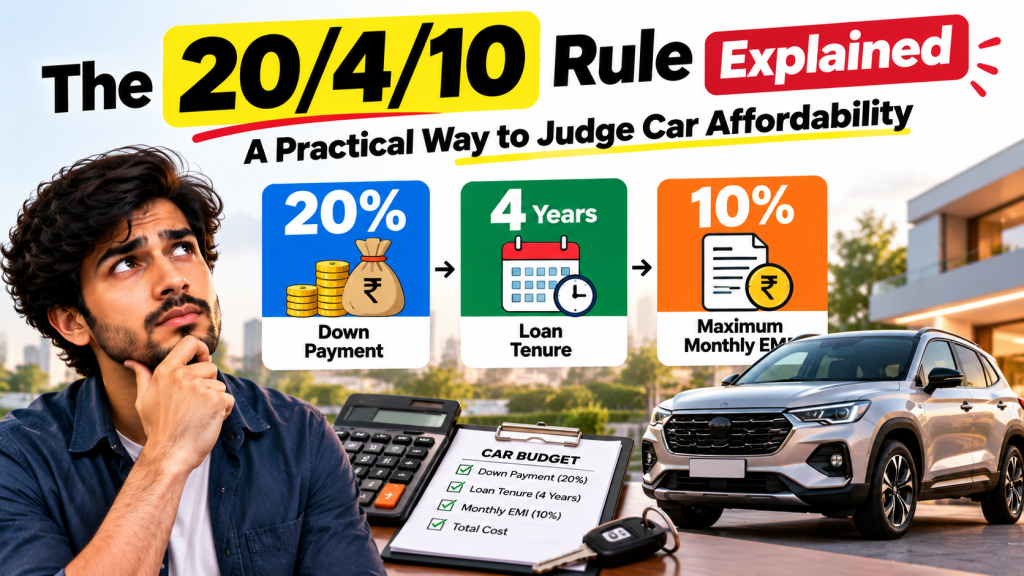
The 20/4/10 rule is a commonly discussed budgeting rule of thumb for vehicle purchases. It generally suggests putting around 20 percent down, keeping the loan term around four years, and trying to keep total monthly vehicle costs near 10 percent of gross monthly income. It is not a law, a bank requirement, or a universal financial standard. Its value is that it forces the buyer to consider three things together: how much money goes into the purchase upfront, how long the debt lasts, and how large the monthly burden becomes. The percentages are best treated as starting points for a conversation with your budget.
Your own income stability, household obligations, other debt, savings, and transportation needs may justify being more conservative or, in some cases, using a different framework.
The 20 Percent Down Payment
A 20 percent down payment reduces the amount borrowed and therefore can reduce total interest over the life of the loan. It can also create a buffer against the risk of owing more than the vehicle could reasonably be sold for later. But the down payment should not be so large that it empties your emergency fund. A person with stable income and strong savings may comfortably pay more upfront. Someone with little cash reserve may be better served by keeping a healthy buffer, even if that means buying a less expensive vehicle. The key is to distinguish money available for a purchase from money that protects you from emergencies.
Your emergency fund should not be sacrificed simply to make a loan balance smaller.
The Four-Year Loan Idea
A shorter vehicle loan normally means higher monthly payments but fewer months of interest. A longer tenure lowers the EMI but can significantly increase the total interest paid. It also means that the vehicle can remain financed for a large portion of its useful life. Four years is therefore a useful benchmark because it pushes buyers toward a reasonably short debt period. Yet the ideal tenure still depends on cash flow. If a four-year EMI forces you to miss essential savings every month, the solution may be a cheaper vehicle or a larger down payment rather than simply stretching the loan.
Debt should fit the budget, not the other way around.
The Ten Percent Monthly Cost Guideline
The 10 percent part is often misunderstood because transportation cost includes more than the EMI. A practical budget may include the EMI, fuel or charging, insurance, parking, maintenance, and tolls. Even when a simplified rule looks manageable on paper, real ownership costs can be higher. For example, a person may calculate an EMI of a certain amount and forget fuel and maintenance, making the actual monthly burden significantly larger. The rule becomes more useful when you treat 10 percent as a warning line rather than a guarantee. The lower your transport cost relative to income, the more room you typically have for savings and unexpected expenses.
A Simple Example
Imagine a household with a stable gross monthly income of 100,000 units of currency. Ten percent is 10,000. If the vehicle’s EMI alone is 9,000, the buyer has very little room under a strict interpretation of the rule once fuel, insurance, maintenance, and parking are added. A better choice might be a lower-priced vehicle with a 6,000 EMI so the complete transport budget can remain manageable. The example shows why the rule is about affordability, not merely loan eligibility. A bank may approve a much larger amount than a household can comfortably handle while still meeting savings and family goals.
When the Rule Should Be More Conservative
The framework should be tightened when income is variable, there are large existing loans, an emergency fund is weak, or major expenses are approaching. A person with unstable business income may want a larger down payment and smaller EMI. A household supporting parents or paying education expenses may need more cash-flow flexibility. Someone planning to purchase a home soon should also consider how the car loan will affect future borrowing capacity. Financial rules are strongest when they are used to protect the buyer from optimistic assumptions. Conservative budgeting is especially valuable for depreciating assets because the asset itself generally does not produce income.
When the Rule Can Be Adjusted
There are situations where the rule can be adjusted upward or downward. A high-income household with very low debt, substantial liquid savings, and a genuine need for a particular vehicle may reasonably spend more than 10 percent on transportation. Conversely, a lower-income household with irregular cash flow may need to target far below 10 percent. The purpose of a rule of thumb is to create discipline, not to replace personal analysis. A useful process is to compare the proposed vehicle cost with a complete household budget including savings goals, debt repayment, insurance, and emergency reserves.
If the vehicle pushes other priorities off the table, it is too expensive no matter what a percentage rule says.
How EMI Psychology Can Mislead Buyers
Consumers are often influenced by a low monthly EMI because it makes a large purchase feel small. But a lower EMI may simply mean a longer tenure or a larger final payment. Always ask three questions: How much am I borrowing? How much will I pay in total? How many years will I make payments? Then ask what happens if the vehicle needs a major repair or if income falls temporarily. Looking only at the monthly figure hides the opportunity cost of the money. The money spent on a vehicle loan cannot simultaneously be invested, kept as emergency savings, or used to reduce other expensive debt.
Use the Rule as a Checklist
A strong affordability checklist can be simple: emergency fund intact, high-cost debt under control, down payment available from savings, EMI sustainable, total transport cost reasonable, loan term not unnecessarily long, insurance and maintenance budgeted, and future goals still funded. The 20/4/10 rule can sit inside this checklist. It is most helpful when it triggers questions rather than when it is followed blindly. You do not need a perfect percentage to make a good decision. You need a budget that survives real life, including bills you did not plan for.
Final Takeaway
The 20/4/10 rule is best understood as a financial speed limit for vehicle buying. Twenty percent down can reduce borrowing, four years keeps debt relatively contained, and a ten percent monthly cost target encourages the buyer to avoid overcommitting income to a depreciating asset. But your own circumstances matter more than the rule. The right vehicle is one that meets your needs while leaving enough cash flow for savings, emergencies, insurance, and everyday life. Use the rule as a first filter, then build a complete budget before signing a loan agreement.