India’s Great Mobility Transition: Electric, Hybrid, and the Multi-Fuel Future
Something remarkable is happening on Indian roads. In August 2026, for the first time in history, cars running on “alternative fuels” — a category that includes electric vehicles, CNG, and hybrids — overtook petrol cars in monthly sales. This is not a statistical blip. It is a signal that India’s automotive market is undergoing a fundamental transformation.
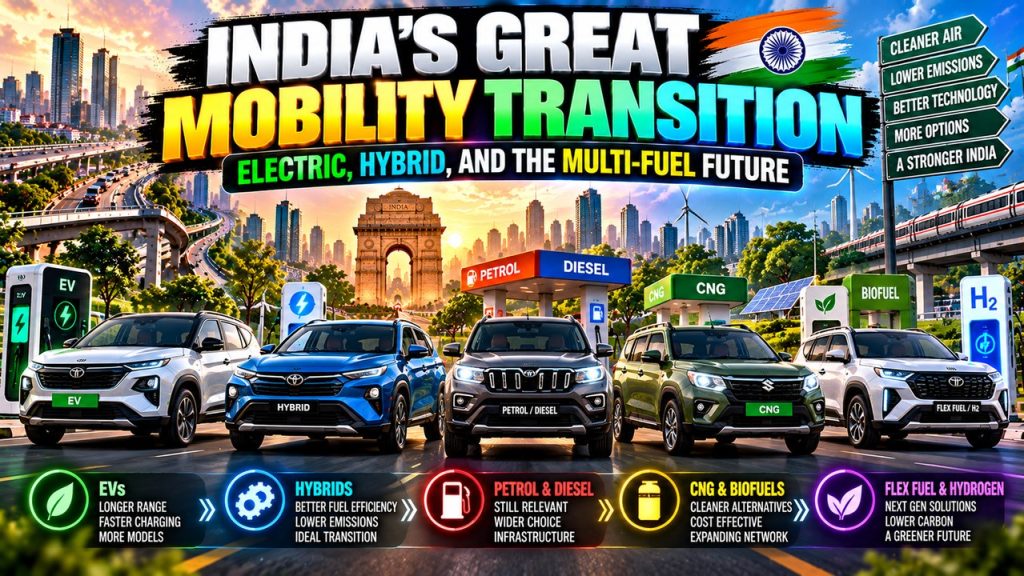
But the shift is not a simple story of electric vehicles replacing petrol engines. It is a complex, multi-layered transition involving electric cars, strong hybrids, CNG, biofuels, and a dozen other technologies competing for the same road space. Understanding this transition is essential for anyone planning to buy a vehicle in the next few years — or anyone trying to make sense of where India is heading.
The Electric Inflection Point
Nomura, the global investment bank, declared in October 2026 that electric vehicle adoption in India has reached an “inflection point”. The numbers support this claim. EV penetration in passenger vehicles rose to 7.9% in September 2026, up from just 4% in FY26. In the two-wheeler segment, penetration increased to 11.6% from 6.5%.
The economic case for EVs has become compelling. The breakeven period for owning an electric scooter over a petrol scooter has fallen to around 2.4 years. For electric cars, the breakeven period is roughly three years for compact SUVs, 2.5 years for mid-size SUVs, and just two years for large SUVs. In simple terms, the higher upfront cost of an EV is now recovered in a reasonable timeframe through lower running costs.
The shift is so significant that India has outpaced the United States in the share of fully electric new car sales for six consecutive months starting in April 2026. This makes India one of only 15 countries to surpass the US in battery electric vehicle sales share. The reversal comes as the US electric market share dropped to 6% following federal incentive rollbacks, placing it behind 49 of the 56 nations tracked globally.
Homegrown automakers Tata and Mahindra together captured more than 60% of India’s electric vehicle sales in the first half of 2026, supported by a ramp-up in local production capacity. The luxury segment is also growing, with sales led by BMW and Mercedes-Benz jumping 61% to a new high of 5,404 EVs in FY2026. Tesla, which finally entered the Indian market, registered 291 Model Ys in September 2026 alone.
The Hybrid Counter-Revolution
While electric vehicles grab headlines, hybrids are quietly gaining ground. The Renault Duster Strong Hybrid, which launched in October 2026, delivers an ARAI-rated fuel efficiency of 29 kilometres per litre — a figure that would have been unthinkable for an SUV just a few years ago. The system combines a 1.8-litre petrol engine with two electric motors and a 1.4 kWh battery pack, producing a combined 160 horsepower.
Hyundai Motor Group has announced plans to introduce 20 internal combustion engine vehicle variants and six electric and hybrid variants in India by 2030. The company aims for eco-friendly vehicles — including electric, hybrid, and hydrogen fuel-cell models — to account for about 50 percent of its sales by 2030. This commitment from one of India’s largest carmakers signals that the future is not electric-only. It is a mix of technologies.
Plug-in hybrid electric vehicles (PHEVs) are also set to grow in India, with new models coming in 2026. The PHEV market offers a bridge between conventional petrol cars and full electric vehicles, allowing drivers to use electric power for short commutes and petrol for longer journeys where charging infrastructure may be limited.
The Multi-Fuel Future: Beyond Ethanol
India’s strategy for reducing crude oil dependence is not limited to electrification. The government is pursuing a diversified fuel mix that includes ethanol, compressed biogas, biodiesel, LNG, methanol, and green hydrogen.
Under the Ethanol Blended Petrol Programme, India achieved approximately 19.05% ethanol blending in petrol, marking a significant milestone toward nationwide E20 implementation. The programme has facilitated payments of over ₹1,50,925 crore to farmers from ESY 2014-15 up to February 2026. This is not just an energy policy. It is an agricultural income policy.
The SATAT initiative, which promotes Compressed Biogas (CBG), has fixed phase-wise mandatory blending targets of 1%, 3%, and 4% of total CNG and PNG consumption for FY 2025-26, 2026-27, and 2027-28 respectively, rising to 5% from FY 2028-29 onwards. CBG, often called Bio-CNG, is produced from agricultural residues and cattle dung, converting waste into usable fuel while creating additional revenue streams for farmers.
Green hydrogen and its derivatives are also part of the long-term plan. The government has approved indicative blending targets for Sustainable Aviation Fuel of 1% by 2027, 2% by 2028, and 5% by 2030. The National Green Hydrogen Mission targets 5 million metric tonnes of annual production by 2030. Standards for Green Ammonia and Green Methanol were notified in February 2026, strengthening the framework for hydrogen-derived fuels.
The message is clear: the future of mobility will involve multiple fuels, not a single replacement for petrol and diesel.
The Charging Infrastructure Challenge
The rapid adoption of electric vehicles has exposed a critical bottleneck: charging infrastructure. India’s EV charging ecosystem is expanding, but not fast enough to keep pace with sales.
As of 2026, proposals worth ₹503.86 crore have been approved for the installation of 4,874 EV chargers across various states and Central Public Sector Enterprises. Under the FAME-II scheme, the Ministry of Heavy Industries has sanctioned more than 9,000 public charging stations across the country. The PM E-DRIVE scheme, with an outlay of ₹10,900 crore, has strengthened EV adoption through demand incentives and expanded charging infrastructure, with more than 20 lakh electric vehicles sold under the scheme.
Hindustan Petroleum Corporation Limited (HPCL) aims to have around 6,000 chargers by the end of FY27. The company added 640 chargers last financial year and another 541 between April and September 2026. Its network has grown 8% to 5,826 charging facilities, comprising 2,180 AC slow chargers and 3,656 DC fast chargers.
HPCL plans to deploy around 100 chargers rated at 240 kW along strategic highway corridors to reduce charging time and support long-distance EV travel. The company is also expanding beyond fuel stations into residential complexes, offices, malls, and fleet depots, using partnerships and asset-light models. It has installed charging stations at eight residential welfare associations in Mumbai and Bengaluru.
But challenges remain. HPCL has called for electricity tariff reforms, lower demand charges, and faster power connections to improve the viability of public charging infrastructure. DC fast chargers may require utilisation of 15-25% to achieve attractive economics, depending on electricity tariffs, capital costs, and operating expenses. The newly launched Unified Bharat e-Charge app is expected to strengthen the ecosystem by making charging infrastructure more accessible and convenient for users.
Government Policy: A ₹92,000 Crore Bet on Electric Mobility
The scale of government support for electric mobility is unprecedented. Shri Rajiv Gauba of NITI Aayog highlighted that government support totals over ₹92,000 crore through schemes such as FAME, PM E-DRIVE, and PM E-bus Sewa, as well as two production-linked incentive schemes for automobiles and battery storage.
The Production Linked Incentive (PLI) Auto scheme, with an outlay of ₹25,938 crore, is promoting domestic value addition and enhancing global competitiveness. The PLI-ACC scheme aims to establish 50 GWh of Advanced Chemistry Cell battery manufacturing capacity in India. The recently approved Rare Earth Permanent Magnet (REPM) scheme, with a budgetary outlay of ₹7,280 crore, will promote indigenous manufacturing of critical components for electric vehicles, wind turbines, defence systems, and electronics.
India’s dependence on imports for nearly 89% of its crude oil requirements is a strategic vulnerability. As car ownership rises from current levels, this dependence will only increase if EVs are not adopted more widely. NITI Aayog has described the shift to electric mobility as “an economic, environmental, and strategic imperative” for the Viksit Bharat 2047 vision.
Twenty-nine of India’s 36 states and union territories have now notified EV policies. The India Electric Mobility Index scores show broad-based improvement, with the highest state score rising from 77 to 84 and the median score from 36 to 40 over the past year.
What This Means for You
If you are planning to buy a vehicle in the next few years, the landscape is more complex — and more promising — than ever before.
For city commuters: An electric scooter or small electric car is now economically sensible. The breakeven period is short, running costs are low, and charging at home is convenient.
For highway drivers: A strong hybrid like the Renault Duster E-Tech offers excellent fuel efficiency without range anxiety. Plug-in hybrids offer the best of both worlds.
For commercial vehicle operators: CNG and Bio-CNG remain practical options, with an established refuelling network. Electric three-wheelers are already dominant in the L5 segment, with penetration exceeding 50%.
For everyone: The era of the single-fuel vehicle is ending. The future is a mix of electric, hybrid, CNG, and biofuel options, each suited to different needs and different parts of the country.
The transition is not happening overnight. It is a gradual, multi-layered shift driven by economics, policy, and the simple fact that cleaner, cheaper, and more efficient vehicles are becoming available at every price point. The road ahead is no longer just petrol. It is electric, hybrid, and everything in between.