The 2026 Money & Life Blueprint: Car Loans, Credit Cards, Inflation, EVs, and the GTA 6 Wait
The year 2026 is proving to be a masterclass in financial complexity. From the way you finance a car to the way you swipe a credit card, from the price of eggs at the grocery store to the electric vehicle sitting in the showroom and the video game you have been waiting years to play, the rules are shifting under your feet.
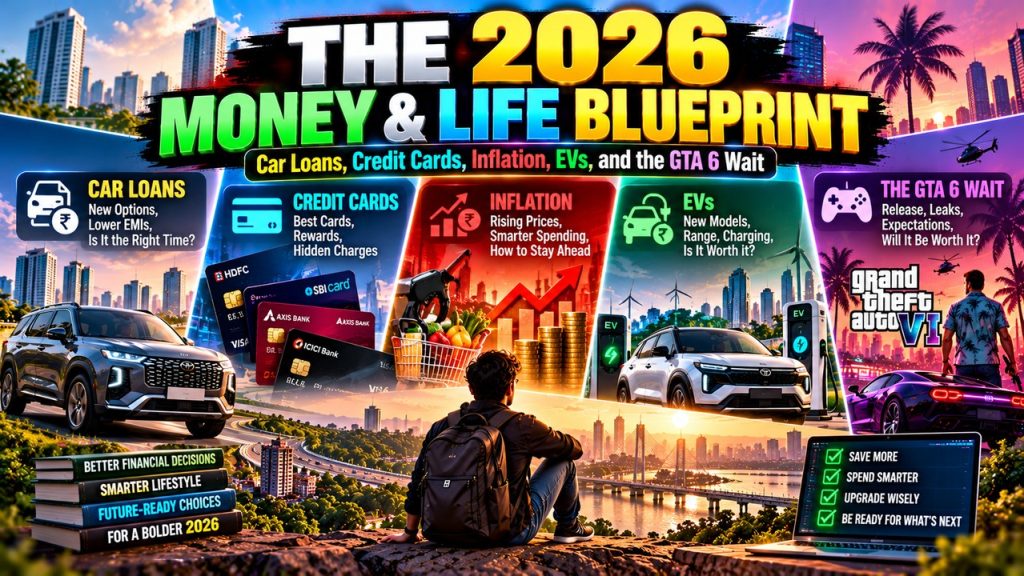
This guide is your plain-language manual for navigating the most important changes of the year. We will cover the 20/4/10 rule for car affordability, the new science of credit card rewards, the real story behind US inflation, a practical EV buying guide, and the long-awaited release of GTA 6. By the end, you will have a clear picture of how to make smarter decisions with your money, your time, and your attention.
Part 1: The 20/4/10 Rule — Your Car-Buying Guardrail
Buying a car is one of the biggest financial decisions most people make. And it is one where emotions frequently override maths. The 20/4/10 rule is a simple framework that keeps car ownership financially manageable and prevents the dream of a new car from turning into years of loan stress.
The rule has three components. Twenty means you should pay at least 20 percent of the car’s on-road price as a down payment. Four means you should repay the loan within four years, or 48 months, to avoid paying excessive interest. Ten means your total monthly car expenses — EMI, fuel, insurance, and maintenance — should not exceed 10 percent of your monthly income.
Why does this matter? Because many buyers focus solely on the monthly EMI, ignoring other ownership costs. A longer loan tenure may reduce the EMI, but it also increases the total interest paid over time. Similarly, a small down payment means higher borrowing and greater financial stress. The 20/4/10 rule helps maintain balance by lowering the overall debt burden, ensuring faster loan repayment, and reducing financial and psychological stress during emergencies.
The rule is particularly relevant in 2026 because the average new car price in the US has crossed $50,000, and the corresponding monthly loan payment averages $772. Nearly 20 percent of new car loans in 2025 had monthly payments of $1,000 or more. Almost 30 percent of trade-ins on new cars involved negative equity, with the underwater amount averaging $7,214 — a record high. The 20/4/10 rule is designed to prevent exactly this situation.
The practical takeaway: Before you step into a showroom, calculate your on-road budget, apply the 20/4/10 rule, and stick to it. The rule is not a straitjacket. It is a guardrail. And guardrails exist for a reason.
Part 2: The New Science of Credit Card Rewards
Credit card rewards in 2026 are no longer about collecting as many cards as possible. The old strategy of card accumulation no longer works because benefits are now tied to spending thresholds. Spreading your spending across multiple cards makes it impossible to unlock value on any single product.
The smarter approach is consolidation. Financial experts now recommend focusing on two to three cards aligned to your core spending categories. With benefits conditional on active usage, disciplined spending on fewer cards beats scattered spending across many.
The reason is simple. The BookMyShow Buy-One-Get-One offer is now conditional on many cards. ICICI Bank credit cardholders must spend ₹25,000 in the previous calendar quarter to access the benefit. HDFC Bank credit cardholders need to spend at least ₹60,000 in the previous quarter to unlock lounge access. If you spread your spending across five cards, you will not hit the threshold on any of them.
The optimal strategy for 2026 involves category optimisation. Assign clear roles to each card: one for travel and ticketing, one for daily expenses like groceries and utilities, and one for online marketplaces. Use timing as a lever. Banks and card networks run campaigns around festivals and e-commerce events that combine instant discounts, accelerated reward points, and cashback offers.
The golden rule: Pay your full bill every month. The rewards are only valuable if you are not paying interest on the balance. Keep your credit utilisation below 30 percent, and never spend simply to earn rewards.
Part 3: Inflation in 2026 — What the Numbers Actually Say
Inflation is the silent tax that eats into every rupee and every dollar you earn. In September 2026, the US Consumer Price Index rose 0.6 percent month-on-month, accelerating from 0.4 percent in August. On a twelve-month basis, inflation stood at 3.7 percent.
The headline number is driven largely by energy. The energy index surged 5.2 percent, led by a 9.1 percent jump in gasoline prices, which accounted for more than half of the overall CPI increase. Shelter costs rose 0.4 percent, and core CPI, which excludes food and energy, increased 0.3 percent.
What does this mean for your wallet? Food inflation is moderate. Food at home rose only 1.8 percent year-on-year, while food away from home rose 3.5 percent. Used car prices actually fell 1.5 percent. But motor vehicle insurance jumped 22.4 percent, and transportation services rose 2.7 percent.
The lesson for 2026 is clear: inflation is not uniform. Some categories are rising sharply while others remain stable or even fall. The smart consumer pays attention to where their money is actually going and adjusts accordingly. If you drive a lot, fuel and insurance are eating your budget. If you eat out frequently, that is another pressure point. Inflation is not a single number. It is a series of choices about where you spend.
Part 4: The EV Buying Guide — Is 2026 the Year to Switch?
Electric vehicle sales in India are booming. In the first half of 2026, electric passenger vehicle sales jumped 79 percent, rising from 82,535 units in H1 2025 to 1,48,023 units in H1 2026. The question is no longer whether EVs are viable. It is whether an EV is right for you.
The first thing to consider is your driving range. If your daily commute is short, an EV with a moderate range may be sufficient. The Tata Punch EV, for example, delivers around 320 km of real-world range in its 40 kWh form, which is more than enough for city driving. If you plan regular outstation runs, choose a larger battery variant.
The second consideration is charging. Look for fast-charging capabilities and access to reliable public charging networks on your daily routes. Home charging is the most convenient option, but it requires a dedicated parking spot with access to a power point.
The third factor is battery warranty. Hyundai, for example, offers long-term ownership support and battery warranty coverage that can give you peace of mind. The Tata Punch EV offers a lifetime battery warranty for the first owner of the 40 kWh version, which is a significant confidence booster.
The fourth consideration is Battery-as-a-Service (BaaS) . This model, popularised by MG and now adopted by others, lets you buy the car and lease the battery separately, reducing the upfront cost. The Tata Punch EV’s BaaS option starts at ₹6.49 lakh plus ₹2.6 per kilometre, which can make EV ownership more accessible.
The bottom line: If you mostly drive in the city, have a place to charge at home, and want to save on fuel and maintenance, an EV is a compelling choice in 2026. If you frequently drive long distances in areas with limited charging infrastructure, a hybrid or petrol vehicle may still be the practical option.
Part 5: GTA 6 — The Wait Is Almost Over
After two delays, Grand Theft Auto 6 finally has a confirmed release date: November 19, 2026, for PlayStation 5 and Xbox Series X|S.
The delays were not unexpected. The game was originally slated for May 2025, then pushed to May 2026, and then again to November 2026. When Rockstar’s head of publishing, Jennifer Kolbe, informed Take-Two CEO Strauss Zelnick about the second delay, his response was blunt: “I think he said, ‘You’re kidding. Please tell me you’re kidding'”. But once he understood the reasons, he supported the decision. Zelnick later said that delaying a game is a “wise investment in time and financial resources” if it results in “the level of perfection it has the ability to reach”.
Rockstar North’s co-studio lead, Rob Nelson, has confirmed that the November date is firm. When asked whether the game would release in November, he stated simply: “It will definitely be released”.
For fans who have been waiting since the game was first announced, the end is finally in sight. Physical copies will be available at retailers on November 12, though the game does not unlock until a week later.
Final Words: The Thread Connecting Everything
These five topics — car loans, credit cards, inflation, EVs, and GTA 6 — may seem unrelated. But they share a common thread.
They all represent moments of decision. The decision to buy a car and how to finance it. The decision to use a credit card wisely or let rewards become a trap. The decision to understand inflation rather than ignore it. The decision to switch to an EV or wait. And the decision to spend your time and money on the things that matter to you.
The lesson for 2026 is simple: do not let defaults make your decisions for you. Do not accept the default of a seven-year car loan. Do not accept the default of collecting credit cards without a strategy. Do not accept inflation as something you cannot control. Do not accept the hype around EVs without checking whether it fits your life. And do not accept the wait for GTA 6 without something else to enjoy in the meantime.
Make the choice. Do the maths. And then enjoy the ride.